
Choosing a digital marketing agency as a startup is quite similar to dating in your early twenties. Everybody looks great in their profile picture, everybody says they want a “long-term partnership,” but three months in to the relationship you find out that nominal decision maker has been ghosting your e-mails and spending your budget on things that don’t budge the needle.
For a startup, a bad hire isn’t just a minor setback—it can be a terminal diagnosis. When you’re burning through seed funding or personal savings, every dollar needs to work like a high-performance athlete.

Why Most Startups Lose Money Choosing a Wrong Digital Marketing Agency

I’ve seen it happen dozens of times: a founder gets a $50k infusion of cash, panics because they aren’t growing fast enough, and hires the first agency that promises “explosive growth.” Six months later, the money is gone, the “leads” were just bot traffic, and the founder is back at square one, but with 50% less runway.
Real Startup Mistakes
Most startups stumble at this hurdle because they recruit for outputs, not outcomes. They think, “I need someone to post on Instagram,” not “I need a customer acquisition strategy.”
- The “Vibe” Hire: Choosing a digital marketing agency because their office is cool or the CEO is charismatic.
- The “Outsource and Forget” Error: Thinking you can just hand off your marketing and never look at it again. Marketing is the heartbeat of your business; you can’t outsource your heart.
Why “Cheap” and “Guaranteed Results” are Traps
When it comes to digital marketing, “guaranteed results” is the mother of all red flags. There is no one on this earth, including Google employees, who can promise that your site will be on page one within a certain amount of time. Algorithms change.Competitors bid higher.
When an agency is “cheap,” they are usually doing one of two things:
- Automating everything: You get a cookie-cutter strategy that doesn’t fit your niche.
- Using junior staff: Your account is being managed by an intern who is learning on your dime.
What Does “Choosing a Digital Marketing Agency” Really Mean?

Before you sign a contract, you must know what it is in stark terms that you actually seek. Is it an agency, freelancer or consultant? Freelancer: Best for consistent projects (example: “I’ll need 5 blog posts per month”). They tend to be less expensive, but don’t have the broad cross-section of a full team. Consultant: They have you do it, but they don’t typically actually do it for you. Great for high-level strategy if you have an internal team already. Agency: A team of specialists. You receive a strategist, a copywriter, a designer and a media buyer.
Why Startups Need Partners, Not Vendors
A vendor fulfills an order. You ask for an ad, they make an ad. A partner challenges you. A partner says, “I know you wanted a Facebook campaign, but looking at your data, your conversion rate on your landing page is so bad that we’d be throwing money away. Let’s fix the page first.”
Startups need partners who understand the “messy middle” of scaling.
Why Startups Are the Easiest Targets for Digital Marketing Scams
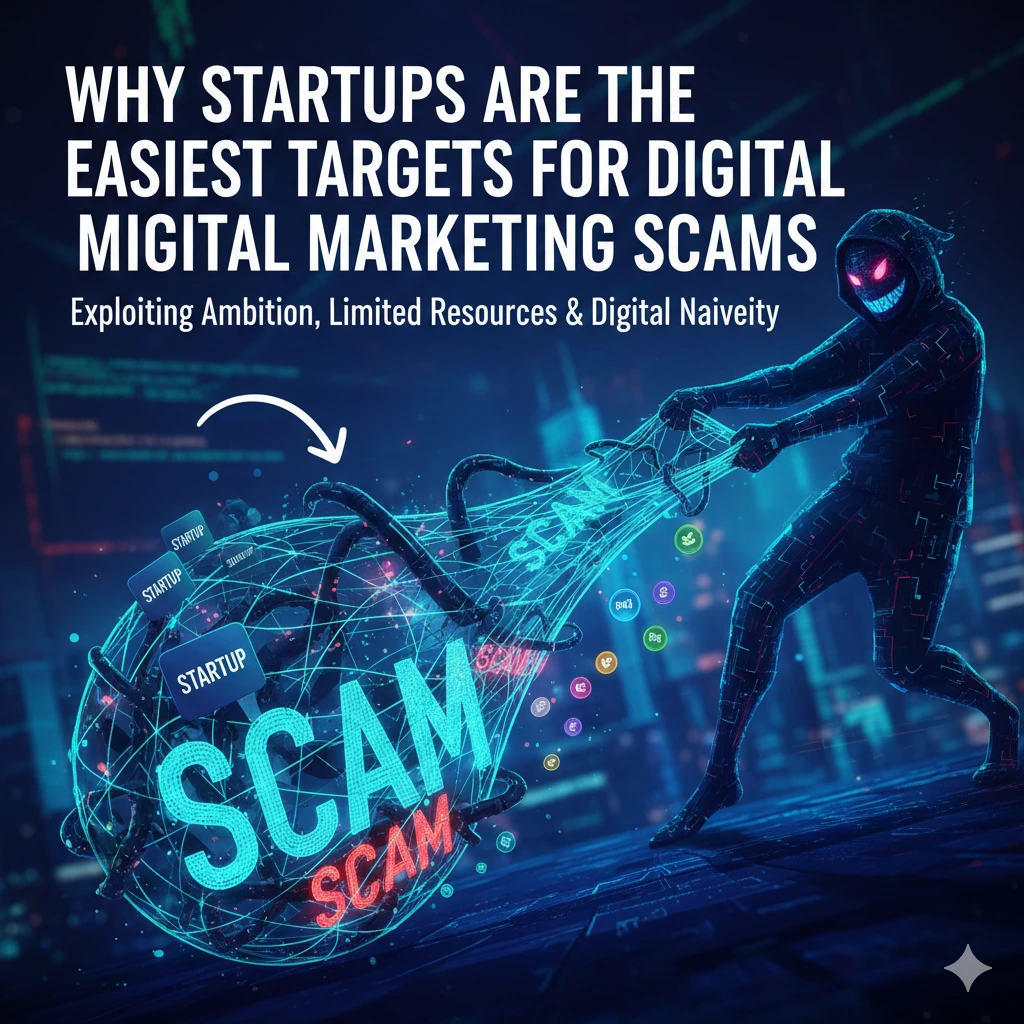
Scammers love startups because startups are often desperate. Desperation creates blind spots.
Psychological Triggers Agencies Exploit
Agencies often use FOMO (Fear Of Missing Out). “If you don’t start SEO now, your competitor will own the space forever.” Or they use Authority Bias, throwing around jargon like “programmatic RTB” or “algorithmic attribution” to make you feel like they know something you don’t.
Lack of Marketing Literacy
If you don’t know the difference between CPA (Cost Per Acquisition) and CPM (Cost Per Thousand Impressions), an agency can easily hide a failing campaign behind “high impression counts.” They show you pretty graphs of “engagement” while your bank account stays empty.
Time Pressure & Funding Fear
Startups are often on a “grow or die” timeline. Scammers know this and promise “quick wins” to exploit that pressure.
Types of Digital Marketing Agencies (And Which One You Actually Need)

Agencies are not all created equal. Choose the wrong type, and it’s like hiring a plumber for electrical work.
Full-Service Agencies: They handle PR and PPC.
- Best for: Midsize companies and higher with large budgets.
Performance Marketing Agencies: They are interested in ROI only and typically have eyes for paid (Google, Meta, TikTok).
- Best for: Startups with a validated business model that want to scale sales quickly.
Niche Specialists (SEO, Email, Content): They are really good at doing one thing.
- Best for: Startups with a single channel they are swim lanes-clear sure works.
✅ Startup Recommendation Matrix
| If your goal is… | You should hire… |
| Testing Product-Market Fit | A Senior Freelance Strategist |
| Scaling Sales Quickly | A Performance Marketing Agency |
| Building Long-term Authority | An SEO/Content Specialist Agency |
| Total Brand Overhaul | A Creative/Branding Agency |
10 Red Flags That Signal a Choosing a Digital Marketing Agency Scam

If you see these, run. Don’t walk.
- “Guaranteed rankings or leadhttps://adrunkaro.com/wp-admin/post.php?post=2376&action=edits”: As mentioned, this is a mathematical impossibility in a competitive market.
- Fake Case Studies: Keep an eye out for ambiguous business names, such as “A leading tech firm.” Be wary if they are unable to identify the client or provide authentic screenshots.
- Ad accounts are not accessible: If they claim, “We run ads through our proprietary dashboard,” they are probably keeping the data for themselves or concealing their markup. Your data should always belong to you.
- Long lock-in contracts: Avoid 12-month contracts upfront. After choosing a digital marketing agency should prove its worth in 3-4 months.
- No reporting transparency: If you only get a PDF once a month, they are hiding something. You need real-time dashboards.
- “Proprietary Technology”: Most of the time, this “tech” is just a white-labeled version of a $50/month software.
- Poor Communication: If it takes 3 days to get a reply during the sales process, imagine how it will be when they have your money.
- Vague Metrics: Focus on “impressions,” “reach,” or “likes” instead of “conversions” or “revenue.”
- They don’t ask about your margins: If an agency doesn’t care how much you make per sale, they can’t run a profitable campaign.
- Extremely low pricing: If they offer SEO for $200 a month, they are likely using “black hat” techniques that will get your site banned by Google.
The Right Questions to Ask Before Choosing a Digital Marketing Agency

Don’t let them do all the talking. Use these:
- “How does our marketing strategy change if our main competitor doubles their budget tomorrow?” is the strategy question.
- Reporting: “Can I see a sample report from a client in a similar industry?”
- Failure Management: “Explain a client campaign that didn’t work out. What did you do, and why did it fail? (Listen for responsibility rather than placing the blame on the client).
- Exit Clauses: “What happens to the creative assets and data if we part ways?”
How to Evaluate an Agency’s Case Studies the Smart Way

Case studies are marketing for marketers. They are designed to look perfect. To see the truth:
- Look for “The Why”: A good case study explains the problem, the specific hurdle, and the logic behind the solution.
- Verify Claims: Use tools like Semrush or Ahrefs to see if a site’s traffic actually grew when the agency said it did.
- Vanity vs. Value: Did they increase “social engagement” by 400% or “attributed revenue” by 400%? One pays the bills; the other doesn’t.
Understanding Before Choosing a Digital Marketing Agency Pricing (So You Don’t Overpay)
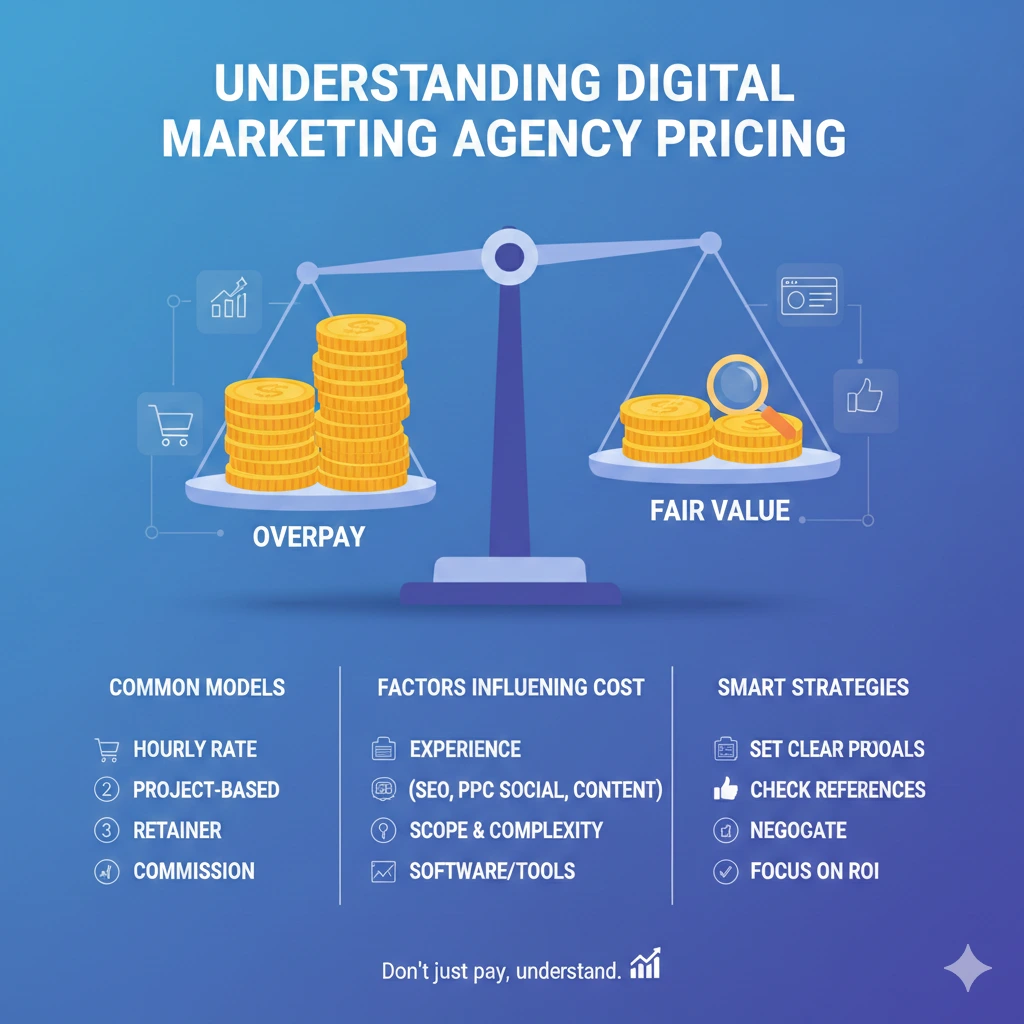
Retainer vs. Performance-Based
- Retainer: A flat monthly fee (e.g., $3,000/mo). Good for predictable budgeting.
- Percentage of Ad Spend: Common in paid media (e.g., 10-20% of what you spend on ads).
- Performance-Based: You pay per lead/sale. Sounds great, but often leads to “low-quality” leads because the agency just wants the volume.
The Golden Rule: A “cheap” agency that costs $1,000/month but generates $0 is infinitely more expensive than an agency that costs $5,000/month but generates $20,000 in profit.
The Startup-Friendly Digital Marketing Agency Checklist
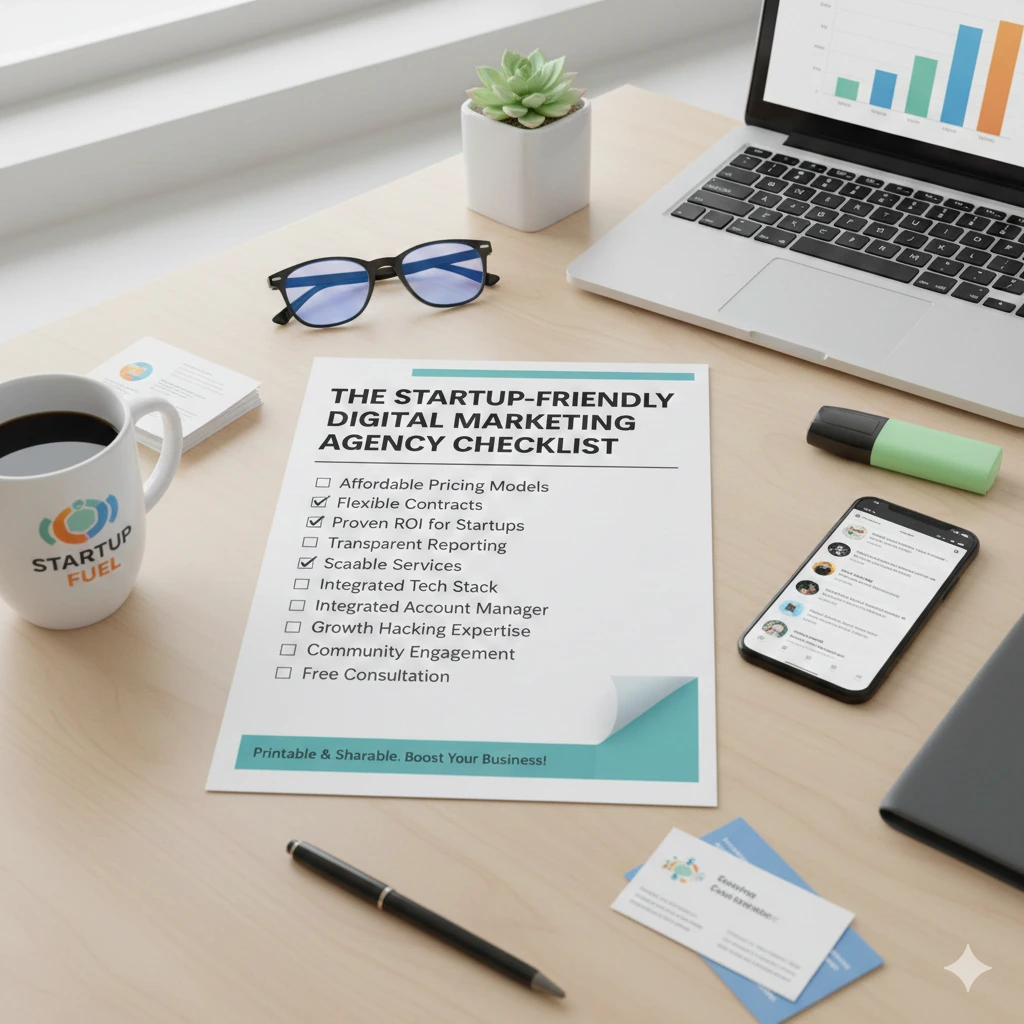
Skills Checklist:
- [ ] Can they explain difficult ideas in simple terms?
- [ ] Do they have experience in your specific industry or B2B/B2C model?
- [ ] Are they experts in the specific platforms you need (e.g., TikTok vs. LinkedIn)?
Process Checklist:
- [ ] Is there a clear onboarding process?
- [ ] Do they use project management tools (Asana, ClickUp, Slack)?
- [ ] Who do I communicate with on a daily basis? (Hint: You don’t want it to be the Sales Rep).
Should You Hire an Agency or Build an In-House Team First?

This is the $100,000 question.
Hire an Agency if: You need to move fast, you need multiple skill sets (design + copy + tech), and you don’t have time to manage a person.
Hire In-House if: Marketing is your core competency, you have the time to train someone, and you need 24/7 focus on your brand.
The Hybrid Model: Many successful startups hire one “Head of Growth” internally to manage 1-2 specialized agencies. This gives you internal accountability with external firepower.
Real Examples: Good vs. Bad Digital Marketing Agency Experiences
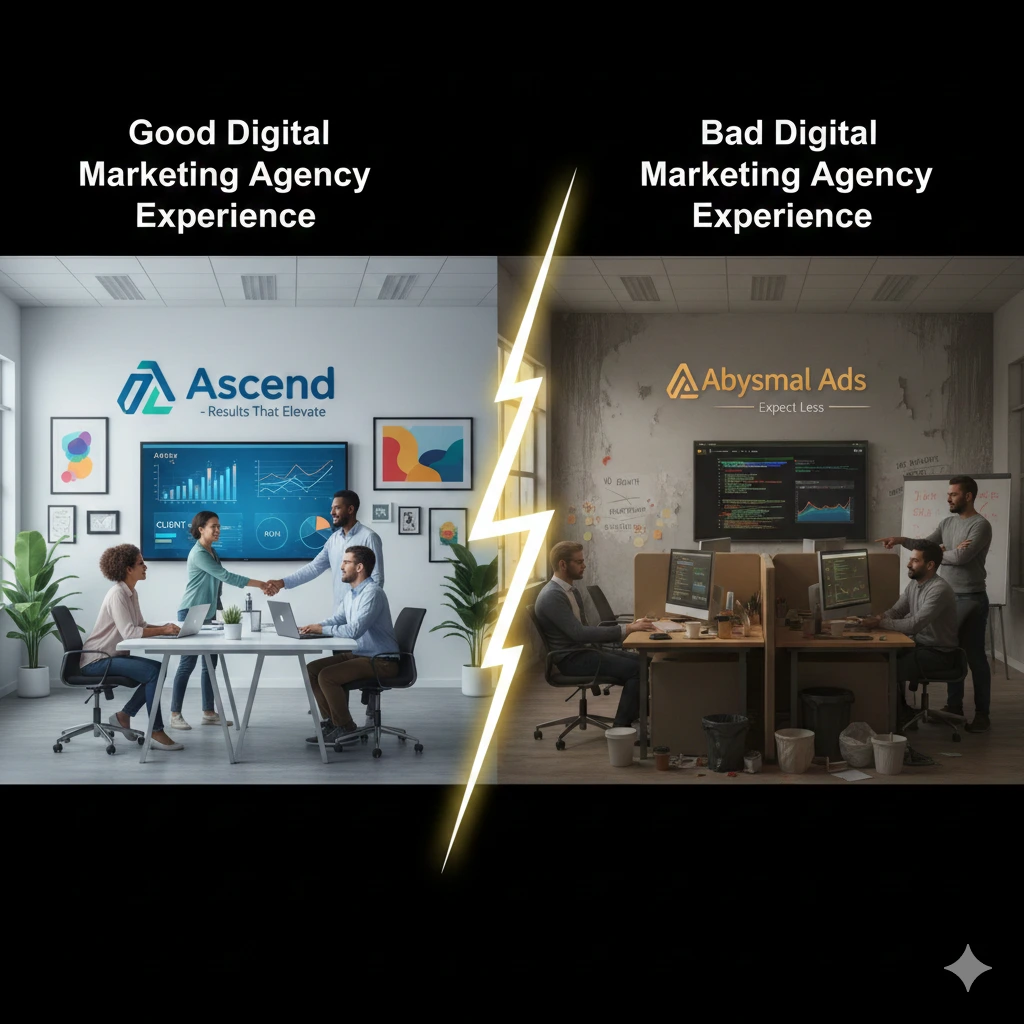
The Bad: A SaaS startup hired a “Growth Hacking” agency. The agency ran ads to a broad audience to get “cheap clicks.” The clicks were real, but the users didn’t need the software. The startup spent $20k in a month and got 2 sign-ups.
- What went wrong: The agency optimized for volume instead of intent.
The Good: A DTC brand hired a specialist email agency. The agency spent the first two weeks just fixing the “abandoned cart” flow and cleaning the list. No new ads were run. Revenue increased by 15% in the first month just from existing traffic.
- What went right: The agency looked at the entire funnel, not just the top.
Final Decision Framework for Choosing a Digital Marketing Agency
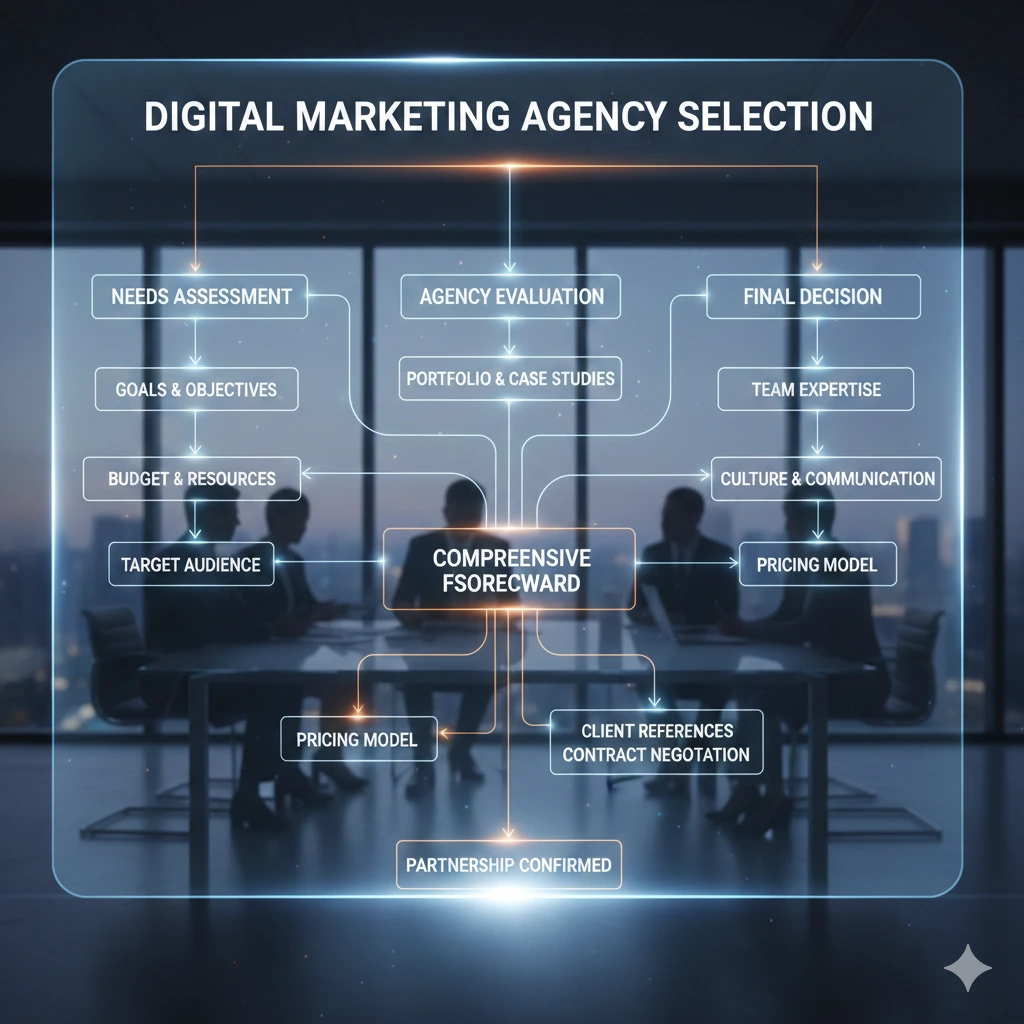
Before you sign, use a Scorecard Model. Rate each agency 1-10 on:
- Technical Competence
- Industry Experience
- Culture Fit (Do you actually like talking to them?)
- Transparency
The Trial Project Strategy:
Never commit to a year. Ask for a paid 30-day “Audit and Strategy” project. If the roadmap they produce at the end of those 30 days is brilliant, hire them. If it’s generic, you’ve only lost a small amount of money and time.
Conclusion: Choosing a digital marketing agency Is a Business Decision, Not a Shortcut
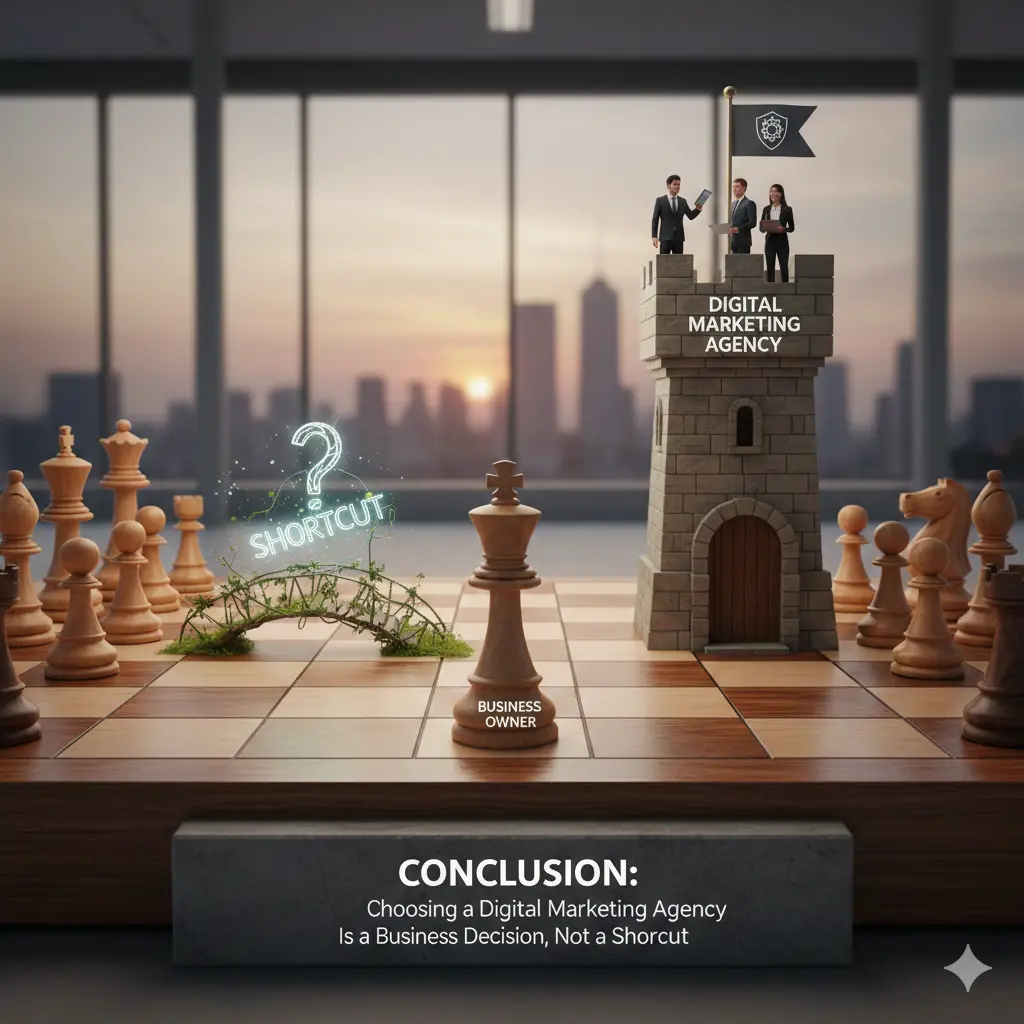
At the end of the day, no agency can save a bad product, but a bad agency can definitely kill a good one. You aren’t just buying “marketing”—you are buying a piece of your startup’s future.
The One Golden Rule for Startups: If you don’t understand how they are making you money, they probably aren’t. Keep your hands on the data, your eyes on the ROI, and never be afraid to fire an agency that treats your budget like a playground.